
SEO and AI search for law firms
Your future clients are not just searching anymore. They are asking full questions and reading full answers, with two or three sources cited underneath. Some of those sources are law firms. Becoming one of them is not luck, and it is not a separate product.
We run search rankings and AI visibility as one program, because they are one problem. The same clean site, the same structured data, and the same genuinely useful content decide whether you rank and whether you get cited. When an agency quotes AI optimization as a second retainer, ask what the second invoice buys that the first one does not.
What the program covers
Seven areas, worked continuously. We will name what gets done and why it matters. The how is the job.
Technical foundation
Speed, mobile behavior, indexing, redirects, and the structural problems that keep good content from being found. Most law firm sites carry years of accumulated mess from previous vendors. We find it, fix it, and keep watching after it is fixed.
Structured data
The machine-readable layer that tells Google and AI systems exactly who you are, what you practice, and where you do it. Legal service, attorney, article, and FAQ markup, written by hand and validated, not left to whatever your platform generates on its own.
Practice area architecture
Each practice area is its own competitive fight, with its own pages and its own map of what clients actually ask. We build and maintain that structure so a firm doing three things reads like an authority in three places, not a generalist in none.
Local signals
Your name, address, and phone number, consistent across every place your firm appears online, monitored every month, with new listings added where they genuinely help. The heavy one-time cleanup happens in the Foundation Retainer. This keeps it clean.
Content
A minimum of two major pieces every month, researched and written from scratch for your practice areas and your market. This is the one part of the program with a number attached, and the section below explains exactly how that works.
AI search visibility
Structuring your pages so AI systems can read them, quote them, and cite them. Direct answers where machines look for them, questions phrased the way clients actually ask them, and the technical signals that make your site usable as a source. This is not an add-on. It is how everything above gets done. If you want the fuller picture of why this matters now, we wrote it up in how search has changed, and why law firms need to change with it.
Measurement
A monthly report connected to the number you actually care about, inquiries, not just rankings. What moved, why, and what happens next. It comes from the person doing the work, because that is who you talk to.
This is watched work
None of the seven areas above is a set-it-and-forget-it task. Google ships updates without announcing them. AI systems keep changing what they cite and how they choose it, and nobody outside those companies fully knows the rules on any given day. What ranked in March gets rewritten by June. The only honest response to a system that keeps moving is someone paying attention while it moves.
So this program is not a setup fee with a maintenance plan stapled to it. It is a standing watch. Your visibility gets checked continuously against your actual numbers, changes get investigated when they happen rather than discovered at renewal time, and adjustments get made while they are still small. The firms that hold their ground in search are not the ones with a perfect website. They are the ones where somebody noticed.
The acronyms other agencies use
You may have heard this work sold under other names. GEO stands for generative engine optimization. AEO stands for answer engine optimization. AIO usually just means AI optimization. Different acronyms, same job: making your firm visible and citable in the answers your future clients get from ChatGPT, from Gemini, and from Google's AI results. Some agencies sell each acronym as its own retainer, often thousands of dollars a month on top of SEO. We include the work in this program, because it is built on the same foundation as everything else on this page. If a proposal prices it separately, ask what the second invoice buys.
What is included, and what is metered
Here is what this program does and does not meter. The technical work, the design and structural changes, the schema, the local signals, the measurement, all of it is simply included. Unlimited. Fix a typo, swap a photo, update your hours, restructure a page, add an attorney bio, chase down a broken redirect. We do not count any of it, we do not bill for it, and you do not have to think about whether a request is worth making.
The only thing with a number attached is major content. A real page or article, researched and written from scratch. The program includes a minimum of two each month. If you want more than two in a given month, additional pieces run $700 each.
The other two ways firms usually handle this
There is the relative or friend who is good with computers, running your marketing between classes or around another job. This is not about her talent. It is that everything on this page only works when someone is watching it continuously, and she has a life that rightfully comes first. When the semester gets busy, your visibility is the thing that waits. And you will not know anything slipped, because nobody was measuring it in the first place.
Then there is the national outfit with the polished sales call. They build the site, set up the monthly charge, and send a report that says things are going well. The report always says things are going well. You are one of nine hundred accounts, the person who sold you is not the person doing the work, and nobody there will ever notice that your inquiries dropped, because nobody there knew what your inquiries were. Out of sight is the business model.
We built this program to be neither. Small enough that your numbers get looked at by a person whose name you know, and serious enough that this is the whole job, not a side one.
What it costs
The program starts at $1,850 a month on a twelve-month agreement, or $2,200 month to month. For comparison, genuine full-service work in the legal market generally runs $2,500 to $6,000 a month. We wrote up the whole pricing landscape, including what the cheap end really buys, in what law firm marketing actually costs in 2026.
Most firms start with a Foundation Retainer. That is a one-time ninety-day cleanup covering consistency everywhere your firm appears online, plus a compliance review of your existing marketing against the advertising rules that apply to you. It starts at $2,500 for a solo attorney and $3,500 for a firm.
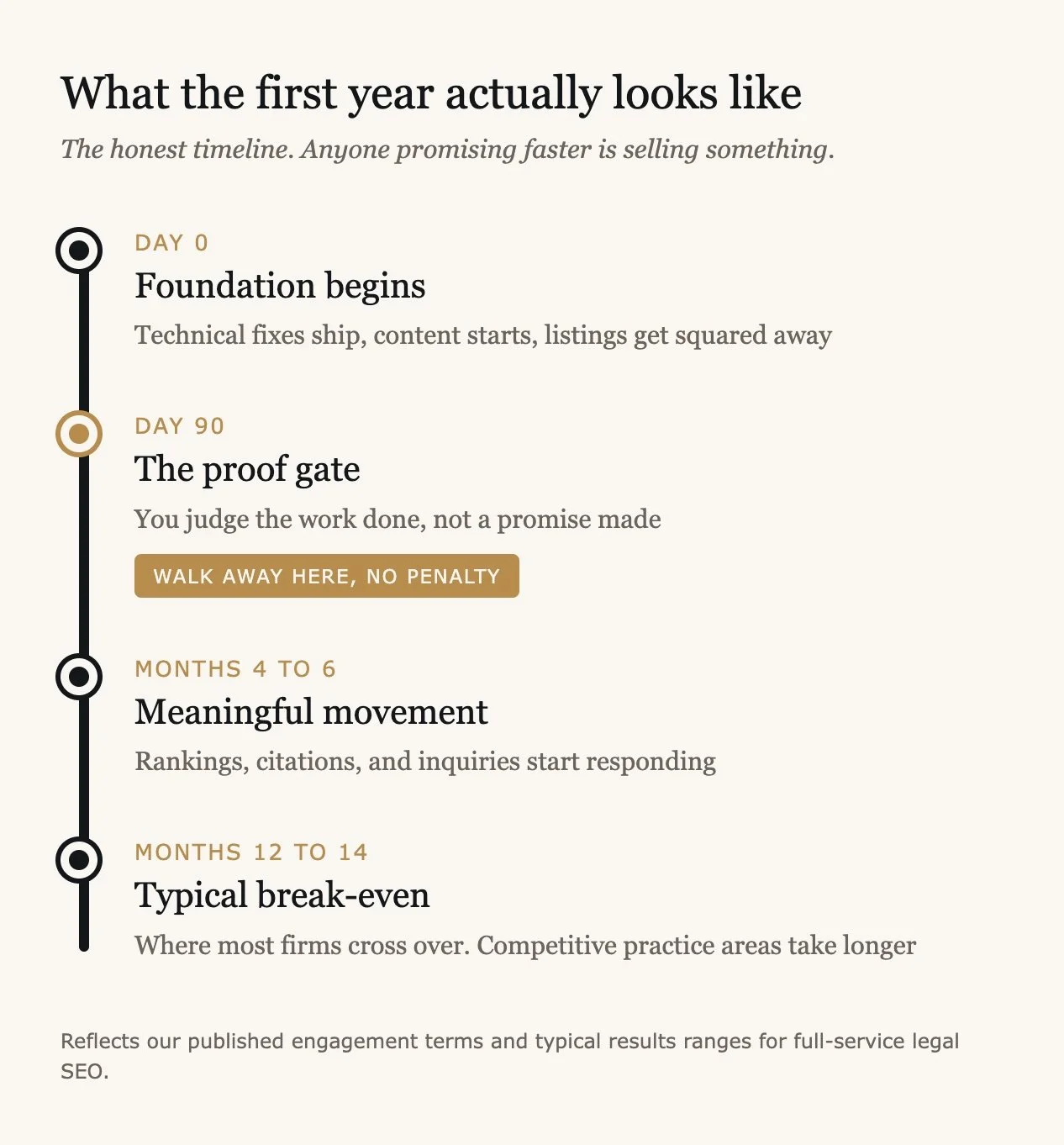
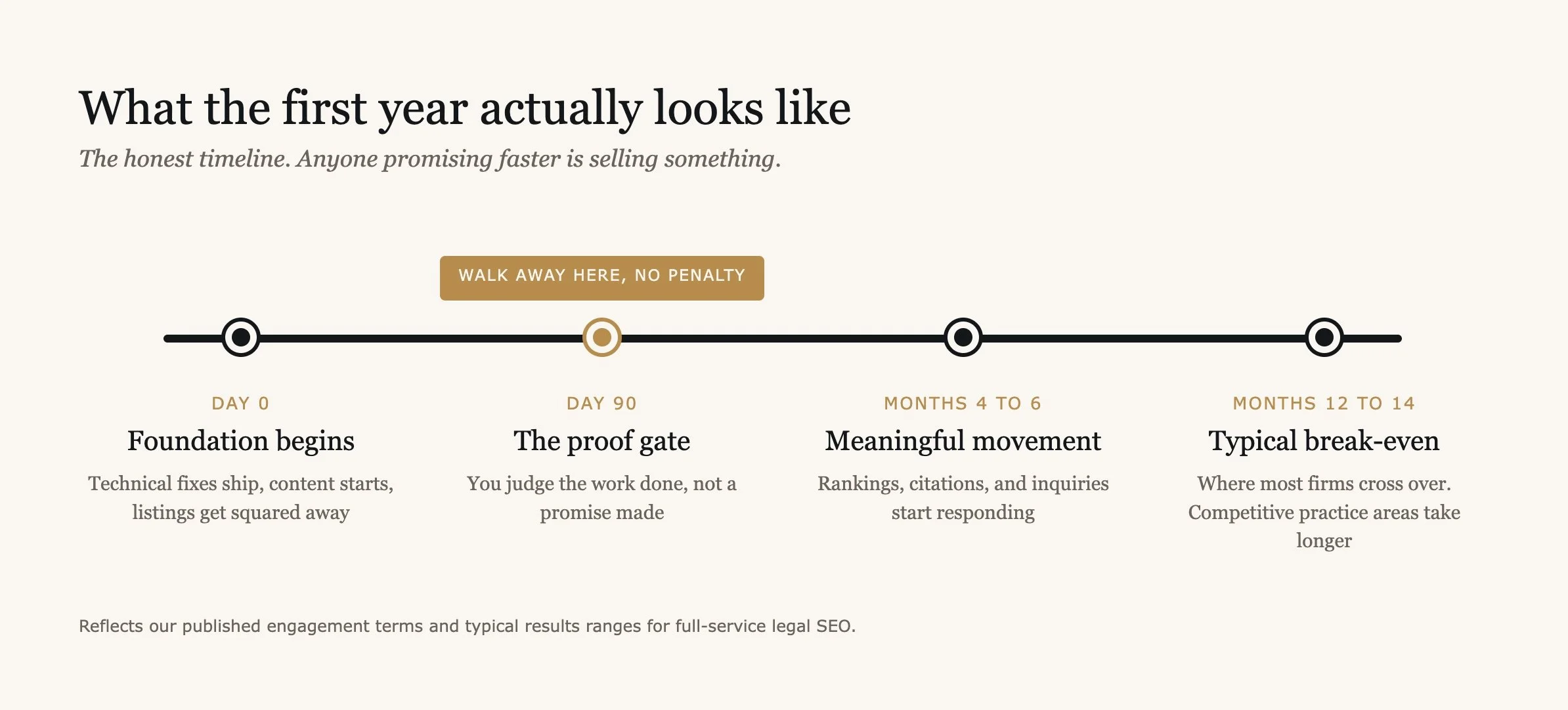
Every engagement has a ninety-day proof gate. If the work has not proven itself by then, you walk with no notice period and no penalty, and month three is your last billed month. After the gate, ordinary exits take thirty days notice. We would rather earn month four than bill it.
Frequently asked questions
Is AI search optimization included, or does it cost extra?
It is included, because it is not separate work. Search optimization and AI visibility share the same technical foundation and the same content, so we run them as one program with one invoice. Agencies quoting a second retainer for AI optimization are charging twice for one job. This work is sometimes sold as GEO (generative engine optimization), AEO (answer engine optimization), or AIO (AI optimization). Different acronyms, same job, one invoice.
What counts as a major content piece?
A real page or article, researched and written from scratch, like a practice area page or a substantive article. Typo fixes, photo swaps, hours updates, attorney bios, and all technical or structural work are maintenance, which is included and never counted.
How much does the program cost?
It starts at $1,850 a month on a twelve-month agreement, or $2,200 month to month. A one-time Foundation Retainer usually comes first, starting at $2,500 for a solo attorney and $3,500 for a firm.
How long before it produces results?
Meaningful movement usually takes four to six months, and most firms reach break-even somewhere around month twelve to fourteen. Competitive practice areas take longer. The first ninety days are about foundation and early signals, which is exactly what the proof gate below measures. Anyone promising full results faster is either misunderstanding the work or misrepresenting it.
What happens if it is not working?
Every engagement has a ninety-day proof gate. Ninety days is not enough time for full results, and we will not pretend it is. It is enough time to see whether the work is real. The technical fixes shipped, the content published, the early signals moving the right direction. If you look at what has actually been done by day ninety and do not want to continue, you walk with no notice period and no penalty, and month three is your last billed month. After the gate, ordinary exits take thirty days notice.
Who do you work with?
Law firms only, anywhere in the United States. Working with one industry means we are not relearning yours on your budget.
Wondering where your firm's search picture actually stands? Send a flare and we will tell you honestly, whether or not we end up working together.