
Search has changed, and law firms need to change with it
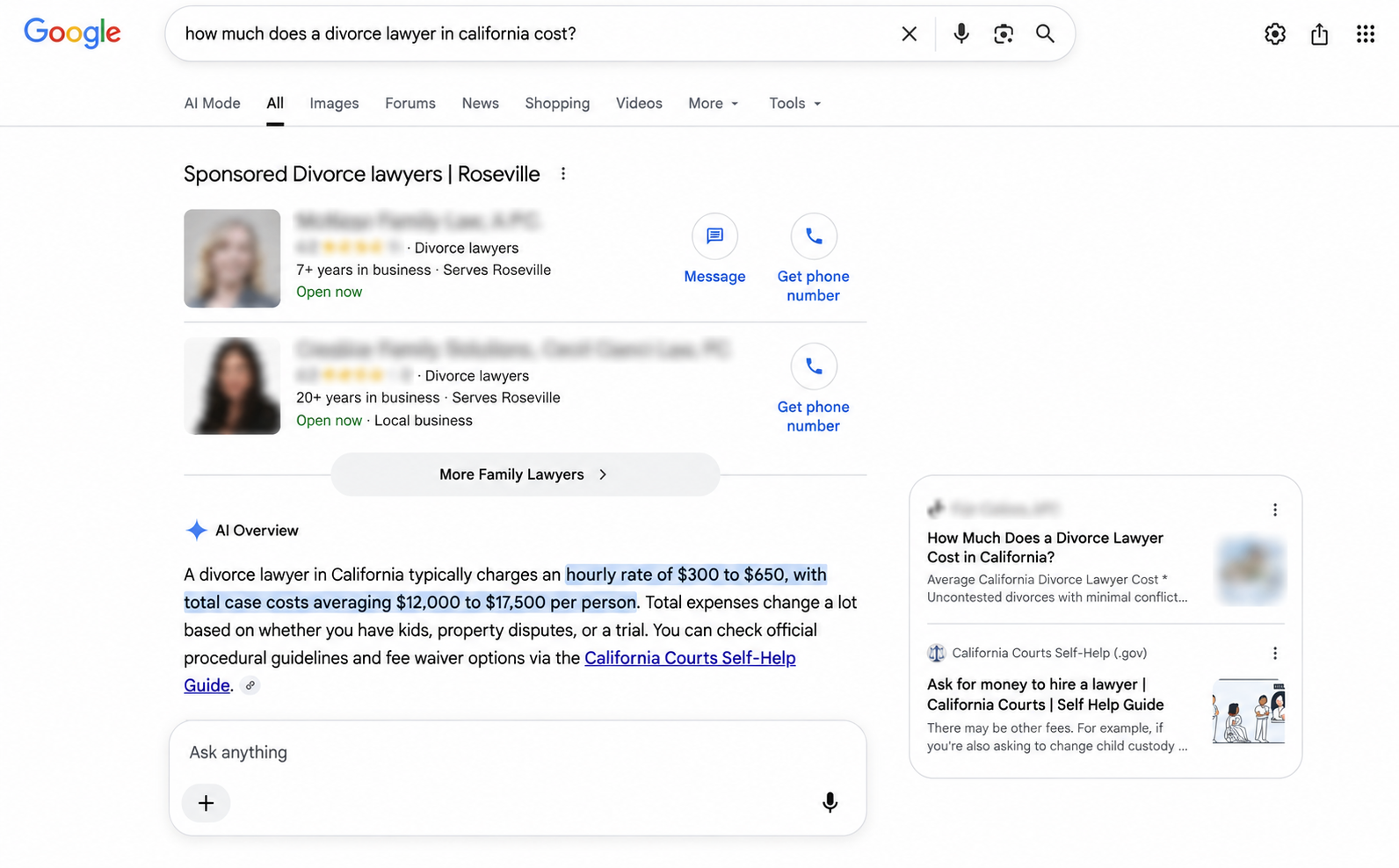
A single search for a California divorce lawyer: two paid listings, an AI Overview with the answer, and one firm cited as a source.
Ask ten people how they found their last attorney and you will get ten different answers. One typed a phrase into Google and called the third result. One asked a coworker. One scrolled reviews for twenty minutes at 11 p.m. And a growing number will describe something that barely existed a few years ago. They asked a question, in full sentences, and something answered them before they ever saw a website.
That last group is the one reshaping legal marketing right now.
The short version
AI optimization, usually shortened to AIO, is the work of making your law firm easy for AI-powered search tools and answer engines to understand, trust, and reference. Traditional SEO tries to win a position on a results page. AIO tries to get your firm included in the answer itself. The two are not competitors. AIO sits on top of solid SEO, and firms with weak fundamentals struggle at both.
Nothing in this article is legal advice, and none of it replaces a careful read of your own state bar's advertising rules.
How people search for a lawyer now
For a long time, search rewarded firms that guessed the right keyword. A prospective client typed "personal injury lawyer near me," and your job was to be one of the ten links that came back.
Now people ask questions the way they would ask a friend.
"Who handles contested custody cases in my county?"
"The insurance adjuster already called me. Did I mess up?"
"What happens if I miss a court date in Placer County?"
Those are not keywords. They are situations. And AI search tools are built to read the web, summarize what they find, and hand back an answer with a few suggested sources attached. If your site does not clearly explain who you help, where you help them, and why anyone should believe you, there is very little for those systems to work with.
The firms getting squeezed are not the ones with bad websites. They are the ones with interchangeable websites.
How many people are actually seeing AI answers?
In March 2025, Pew Research Center tracked the actual browsing behavior of 900 U.S. adults across 68,879 Google searches. Fifty-eight percent of them ran at least one search that returned an AI-generated summary. That figure gets quoted constantly. The numbers underneath it are the ones that should get your attention.
Those summaries do not appear evenly. Only 18 percent of all searches in the study produced one. But 60 percent of searches that began with a question word, who, what, when, or why, produced one. Searches of ten words or more produced one 53 percent of the time. One-word and two-word searches produced one just 8 percent of the time.
Read that with your intake calls in mind. Short generic keyword searches are barely affected. The long, specific, anxious questions someone types at 11 p.m. after a car accident are exactly the searches getting answered before a law firm website enters the picture.
It gets sharper. When an AI summary was present, users clicked a traditional result in only 8 percent of visits, compared with 15 percent when no summary appeared. They clicked a link inside the summary itself just 1 percent of the time. And 26 percent ended their browsing session entirely after seeing a summary, versus 16 percent on standard results pages. Ranking well and being seen are no longer the same thing.
Meanwhile the audience keeps growing. In a February 2026 survey, Pew found that about half of U.S. adults now report using AI chatbots, up substantially from the summer of 2024, including roughly one in four who use them daily.
Your website has not become less important because of any of this. It has to work harder, because by the time someone finally arrives, they have usually already formed an opinion.
Why the old SEO guard is falling behind
SEO did not stop working. Plenty of agencies just stopped updating what they mean by it.
You can still find law firm marketing companies selling a 2018 checklist. Repeat the keyword a few more times. Publish a 600-word blog nobody reads. Stuff eleven city names into a footer. Buy a handful of directory links. Send a monthly ranking report with a green arrow on it and call that progress.
That approach can still move a number on a spreadsheet. What it does not do is give a stressed, uncertain person any reason to pick up the phone, and it does not give an AI system any reason to cite you over the firm down the street.
There is a difference between a report that looks good and a marketing program that produces intake calls. Most firms only discover which one they are paying for after a year of it.
How people actually pick a lawyer now
The old path was clean. Search, click, read, call.
What we see now looks more like this. Someone asks a detailed question and reads a summary. They compare three or four firm names. They check reviews. They visit a website. They read the attorney bio, because they want to know who they would actually be sitting across from. They search the firm name by itself to see what comes up. Maybe they check social. Then, eventually, they call.
That is a messier journey, and it is genuinely good news for firms that have their house in order. Every one of those steps is a chance to look more credible than the competition. It is also a lot of surface area to leave unattended, which is where most firms lose people without ever knowing it happened.
Why every law firm website sounds the same
Open five law firm websites in your practice area and you will read some version of the same four sentences. We fight for our clients. Decades of combined experience. Aggressive representation. Results matter.
Those statements might all be true. They are also unfalsifiable, indistinguishable, and completely unusable to a person trying to decide between you and someone else.
What actually earns attention is specificity. What kinds of cases do you take, and which do you turn away? What does the first ninety days really look like? What do people get wrong before they call an attorney? What is different about how the courts in your area handle this? Which client is a good fit for your firm, and which one is not?
Depth is what gets summarized. A page that only says "call us today" gives an answer engine nothing to work with, and it gives a nervous prospect nothing to hold onto either.
Can a machine tell who your firm is?
In search marketing, an entity is a clearly identifiable thing. A business, a person, a place, a service, a topic. Your firm is one. So is each of your attorneys, each practice area, and each city you serve.
AI systems get more confident about a firm when those relationships are unambiguous and consistent everywhere they appear. When your name, address, and phone number vary across directories, when three practice pages describe overlapping services in slightly different language, or when your best attorney's credentials live only on a LinkedIn profile, you are asking a machine to guess. It usually guesses conservatively, which means it recommends someone else.
Most of the firms we audit have this problem and have no idea. It is rarely one dramatic mistake. It is forty small inconsistencies that accumulated over eight years and three different marketing vendors.
Local search got more contextual
Legal work is local, and that has not changed. What changed is how the question arrives.
It used to be "estate planning attorney Rocklin." Now it is closer to "how do I help my parents set up a trust so their house doesn't go through probate." Same intent, entirely different shape. A thin city landing page does not answer that. Content grounded in real local procedure, real timelines, and real client questions does.
Your Google Business Profile is doing more work in that journey than most attorneys realize. For a lot of consumer-facing firms, it is the single highest-converting asset in the funnel, and it is usually the one nobody has touched since it was claimed.
Reviews do more work than they used to
Reviews were always persuasive. Now they are also structural. Prospective clients read them, Google treats them as local trust signals, and AI systems appear to weigh sentiment and consistency when they compare businesses for a user.
Legal marketing has guardrails here that other industries do not. ABA Model Rule 7.2 permits lawyers to communicate about their services through any media while limiting compensation for recommendations, and state rules layer on top of that. Incentives, implied guarantees, and anything that touches client confidentiality are all places where a well-meaning review campaign can create a real problem.
Steady, ethical review generation with thoughtful responses beats a burst of activity every time, and it does not put your license anywhere near the conversation.
Do you still need traditional SEO?
Weak SEO makes AIO harder, not easier.
If pages are not indexed, if the site is slow, if the structure is a maze, if local signals contradict each other, AI visibility gets more difficult, not less. Google's own guidance on its AI features points back to the same foundations that have always mattered. Crawlability, indexing, useful content, clean structure.
So the fundamentals stay on the list. Fast pages, mobile-first design, clean architecture, real internal linking, accurate business information, practice-specific content written for humans. AIO rewards firms that build on that foundation. It does very little for firms that skipped it.
How we approach this at Local Law Marketing
We are a small U.S.-based team, and we work with law firms specifically. That is a deliberate limit. Marketing that works for a roofing company or a med spa can get an attorney into trouble, and most general agencies do not know where those lines are until someone points them out.
We treat SEO and AIO as one system rather than two products, because splitting them is mostly a sales tactic. The work starts with understanding how people in your market actually search for what you do, which is rarely the way the keyword tools suggest. From there we look at where your firm is legible and where it is not, across your site, your local presence, your reputation, and your content.
We are not going to publish our research process or our audit framework here. Same reason you do not post your case strategy on your website. What we will say is that it is not a checklist, it is not outsourced, and it does not produce the same forty-page template every other firm in your city received.
What you should expect from us is direct communication with the people doing the work, a plan that connects to intake rather than to vanity metrics, and honesty about what a given investment can and cannot do.
What we will not promise
No marketing company can ethically guarantee rankings, case volume, or a specific number of calls. Anyone who does is either new or hoping you are.
What a well-built strategy can do is put your firm in a materially better position to compete. More qualified calls instead of more calls. Better consultations. Stronger local visibility. A brand that reads as trustworthy at every step where someone is deciding whether to contact you.
Frequently asked questions
What is AI optimization for law firms?
AI optimization is the process of making your law firm easier for AI-powered search tools and answer engines to understand, summarize, and reference. It includes strong technical SEO, genuinely useful content, consistent local and entity signals, reputation management, and clear brand messaging across every place a client might encounter your firm.
Is SEO still important for lawyers?
Yes. AI search features rely on content that can be crawled, indexed, and understood. A firm with thin content, technical problems, or inconsistent local information will struggle in both traditional search and AI-assisted search. SEO is now the entry requirement rather than the finish line.
How is AIO different from SEO?
SEO works to rank your pages in search results. AIO works to get your firm included in, and cited by, AI-generated answers and conversational search. They overlap heavily and share the same foundation. AIO expands the strategy rather than replacing it.
Will AI optimization get my firm more clients?
It can improve your visibility where people are increasingly searching, and it can make your firm easier to trust once they find you. No one can guarantee clients or call volume, and you should be skeptical of anyone who tries.
Which practice areas need this most?
Any firm that depends on being found online. It matters most in consumer-facing areas where people research before they call, including personal injury, family law, criminal defense, estate planning, immigration, employment law, and bankruptcy.
When should we start?
Now, without panicking. You do not need to chase every new tool. You do need your website, content, local presence, and reviews in order, because that foundation is what everything else is built on and it takes time to establish.
Where this leaves your firm
Search is becoming more conversational, more summarized, and more trust-driven. That is not a threat to good law firms. It is an opening, because clarity and credibility are finally worth more than keyword density.
If your firm is ready to stop guessing at this, we should talk. We handle website design, SEO and AI optimization, Google Business Profile work, social content, and review management for law firms that want a straight answer and a real person on the other end of the email.
Contact Local Law Marketing and let's take a look at where you actually stand.