
What Are GEO and AEO? A Decoder for Law Firms
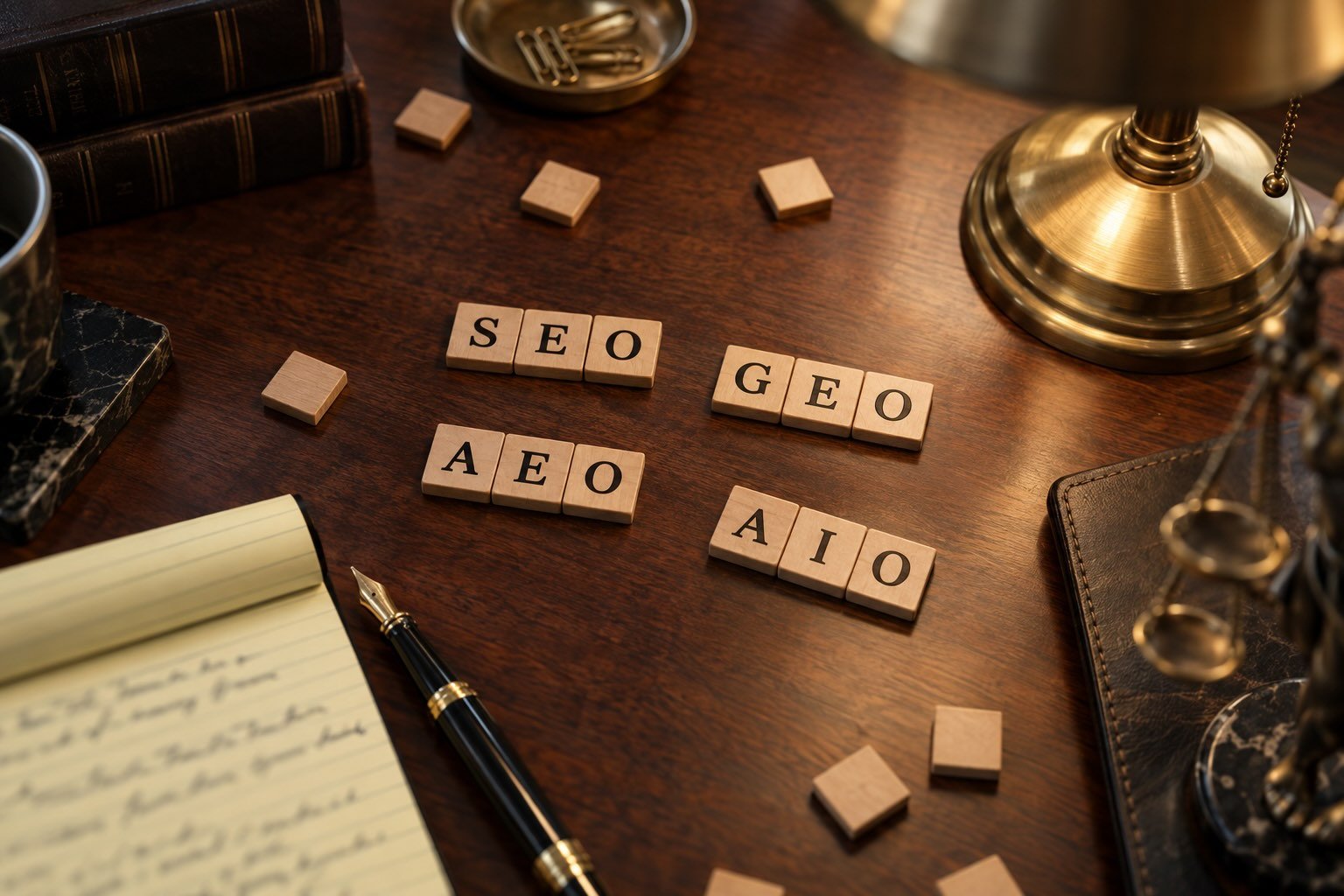
These are all more similar to each other than you’ve been told…
An email lands in your inbox. Your firm is invisible to AI, it says, and the fix is called GEO. Or AEO. Or AIO, or LLMO, depending on which agency wrote it. New acronym, new urgency, new retainer.
Before anyone gets your signature, here is what the letters mean, which parts of the pitch are real, and where the second invoice tends to hide.
One thing first. We sell this work too. AI search optimization is part of our own program, so read everything below knowing where we stand. Our position is that you should understand what things are called and what they cost before you talk to anyone, ourselves included.
The glossary, once and for all
SEO, search engine optimization. The original discipline. Making your website rank in the list of results a search engine returns. Twenty five years old and still the foundation everything else stands on.
GEO, generative engine optimization. Making your firm one of the sources an AI system cites when it writes an answer. When Google's AI Overview or ChatGPT answers "how much does a divorce lawyer cost in California," GEO is the work of being in that answer.
AEO, answer engine optimization. The broadest umbrella. Any system that answers a question directly instead of listing links: featured snippets, voice assistants, and AI answers all count.
AIO, AI optimization. A looser catch-all for the same territory. Some vendors use it for Google's AI Overviews specifically.
LLMO, large language model optimization. The same aim with a more technical costume. Optimizing for the models behind ChatGPT, Gemini, Claude, and Perplexity.
GSO and AI SEO. More names. Same job.
Six acronyms, one job
The industry has not settled on a term, and there is a reason for that. The terms describe one discipline: structuring your website and your online presence so AI systems can find your firm, understand it, and cite it. The work underneath every acronym is the same work. Clear pages that answer real questions. Structured data that validates. One identical firm name, address, and phone number everywhere your firm appears. Content current enough and specific enough to be worth citing.
You do not have to take our word for it. Google published documentation in 2026 on optimizing websites for generative AI features in Search, and its position is that optimizing for generative AI search is still SEO. If your SEO was built for how people search now, the AI work shares its foundation. If your SEO was built in 2015, no acronym purchase will rescue it.
The shift is real, the alphabet is packaging
None of this means the pitch invented the change. The change is genuine and it is fast. Similarweb's 2026 research, reported by TechCrunch in July, found Google's AI Overviews now appearing on 43 percent of US searches, up from 15 percent a year earlier. Roughly a tripling in twelve months. Your next client is increasingly asking a system a question and reading an answer instead of scrolling a list of links. Being one of the handful of cited sources is the new page one.
So the shift deserves your attention. What it does not automatically deserve is a second bill.
Where the second invoice hides
In September we reviewed 13 legal marketing agencies, the national names attorneys actually get pitched by, and looked at how each one prices AI search work. A pattern showed up.
Several agencies sell GEO or AEO as its own retainer, priced from roughly $2,000 to $10,000 per month.
The common structure is a 20 to 40 percent surcharge stacked on top of the SEO retainer.
Same website. Same content calendar. Same structured data and the same entity cleanup. Invoiced twice under two names. When an agency quotes AI optimization as a second retainer, ask what work lives in the second bucket that is not already in the first. The answer is frequently a shrug wearing a lanyard.
Our program prices it the other way because we do not think it is separate work.
Website content plus SEO and AI search program: $1,850 per month on a 12 month agreement.
Month to month: $2,200 per month.
Every engagement begins with a one time Foundation Retainer, $2,500 for a solo attorney, and the AI search work is inside the program, not beside it. Those numbers sit on our website because prices are information, not a reward for sitting through a pitch.

Two paper invoices side by side on a desk, representing SEO and AI search billed as two separate services by most marketing companies
Four questions that sort any pitch
1. Is AI search work included in my retainer or billed separately? If separately, ask what deliverables live in the second bucket that are not in the first. Make them name the work, not the trend.
2. Where does my firm appear in AI answers today? Anyone selling the fix should be able to show you the baseline. Ask the systems your clients use and see whether your firm ever comes up.
3. What exactly changes on my website? Real answers sound like structured data, question and answer content, entity consistency, and citable pages. Vague answers sound like proprietary AI visibility technology.
4. How will you measure it? Citations and mentions in AI answers, growth in branded search, and signed clients are measurements. A dashboard score with no published method is a mood ring.
What the work looks like when it is real
The deliverables are concrete and you can inspect every one of them. Schema markup that validates. Service pages that answer the literal questions clients ask, in full sentences a system can lift and cite. A firm name, address, and phone number that match to the character everywhere they appear. Content written this year, not restated from 2019. Reviews and profiles that agree with the website about who you are.
That is the whole trick, and it is why we fold the work into our SEO and AI search program instead of renaming it and billing it twice. If you want the deeper technical walkthrough of how AI systems read a law firm's site, we wrote one: AI optimization for law firms.
Frequently asked questions
Do law firms need to buy GEO or AEO as a separate service?
No. GEO, AEO, AIO, and LLMO describe the same discipline of making your firm citable in AI generated answers, and the work shares its foundation with modern SEO. Ask whether it is included in your existing retainer before agreeing to a second one.
What is the difference between GEO and AEO?
AEO is the broader umbrella covering any system that answers directly, including featured snippets and voice assistants. GEO is the subset focused on AI systems that write synthesized answers, like Google's AI Overviews and ChatGPT. In practice agencies use the terms interchangeably.
How much does GEO cost for a law firm?
Agencies that price it as a separate retainer commonly charge $2,000 to $10,000 per month, often structured as a 20 to 40 percent surcharge on the SEO retainer. Firms working with us pay nothing extra, the AI search work is included in the website content plus SEO and AI search program at $1,850 per month on a 12 month agreement or $2,200 month to month.
Does Google treat GEO differently from SEO?
Google's own 2026 documentation on optimizing for generative AI features in Search states that the work is still SEO. Clear content, structured data, and a consistent entity are what both the classic results page and the AI generated answers draw from.
Want to know whether AI systems can find your firm today? Tap our shoulder and we will show you where you stand.